KC Tech Talent Trends Report: 2026
This 2026 report showcases the biggest trends within the Kansas City tech market and provides key insights into the local IT workforce.
3 min read

Artificial intelligence (AI) is on the rise, and it doesn’t seem to be stopping any time soon. Because of its rapid ascent and widescale adoption, companies should be aware of its adverse implications and do their part to mitigate them. Like any tool, AI requires its users to be more mindful of how they use it. AI mindfulness refers to a more intentional and responsible use of the rapidly developing technology.
As we recently outlined in our 2026 KC Tech Talent Trends report, AI comes with a host of harmful ecological side effects. This means that more frequent use of the technology could accrue public backlash proportionate to its ever-growing prominence.
Fortunately, tech professionals can address this backlash ahead of time and reduce their carbon footprint by instead employing it only for technical purposes. Most notably, it could be used for lengthy busy-work assignments, such as producing code or summarizing a 100-page document. When it comes to simpler tasks, using Google’s search results may prove more effective, as would person-focused skills, such as critical thinking and creative problem-solving.
To help businesses better understand the environmental implications of increased AI use, we’ve outlined how the tool factors into things such as electricity, carbon emissions, and potable water. We’ll also explore how organizations can respond accordingly to build trust with both active consumers and the general public.
Here in Kansas City, the Northland is already home to multiple data centers that were constructed to meet the increasing demand for AI. But the energy and computing needed for AI and its data centers has led to resistance from environmentalists and frustrated residents paying higher utility bills.
The Midwest is beneficial for AI companies because of the available land. The tech’s effects on the climate and its enormous consumption of resources, however, have placed unwelcome burdens on local communities. As reported by KCUR in 2025, an AI data center consumes 1-5 gigawatts of power, equivalent to the power demand of 1 million homes, leading to blackouts worldwide.
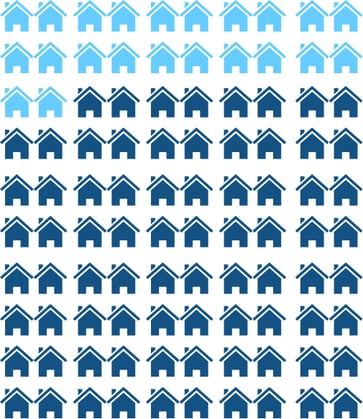
The MIT Technology Review shared that, in 2024, U.S. data centers used roughly 200 terawatt-hours of electricity, a similar amount that powers Thailand for a year. Their research also found that, in the next two years, the power that AI requires could rise to between 165 and 326 terawatt-hours per year, a sufficient amount of electricity to power 22% of American homes, visualized in the graphic below.
A separate MIT report estimates that, this year, AI’s electricity consumption could rise to 1,050 terawatt-hours, which would lead data centers to become the fifth-largest global consumer of electricity in between Japan and Russia.
The carbon footprint of AI, as a result of primarily using fossil fuels for electricity, is significant. Although most companies working on AI, including ChatGPT’s creator, OpenAI, don’t disclose their emissions, Google shared a 2024 report that revealed its greenhouse gas emissions grew by 48% since 2019, attributing that increase to data center energy consumption.
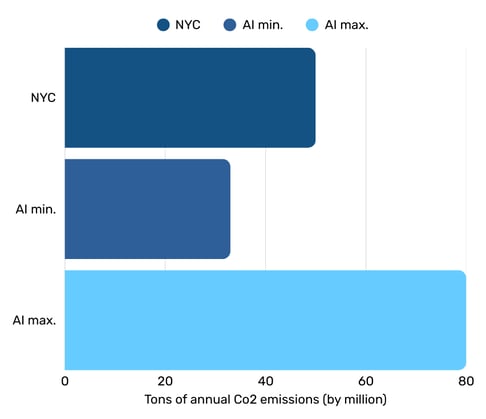
Similarly, a sustainability report from Microsoft revealed that its emissions grew by 29% since 2020 because of the technologies “designed and optimized to support AI workloads.” 2025 research also showed that AI’s annual carbon emissions exceeded those of New York City’s, which is visualized in the chart below.
Data centers require further natural resources beyond electricity. They rely on graphics processing units (GPUs) to handle calculations, and these GPUs require water to prevent overheating.
NPR found that a medium-sized data center can consume up to roughly 110 million gallons of water, equivalent to the water consumption of about 1,000 households. Larger data centers, The Washington Post found, can require up to 5 million gallons per day (or 1.8 billion per year), an amount typical for a town of 10,000 to 50,000 people.
Scientists at the University of California, Riverside, discovered that a standard 100-word AI prompt consumes roughly one bottle of water (519 milliliters) and estimated that water consumption from data centers could reach as high as 600 billion liters by next year. Because that water evaporates and does not return to a local watershed, it is not renewable.
Additional peer-reviewed research has also revealed that, in 2025, AI consumed as much water (446 billion liters) as the global bottled water industry, as visualized by the chart below. The research concluded that AI consumed between 312.5 billion and 764.6 billion liters last year.
.png?width=502&height=420&name=BLOG%20COPY%20Tech%20Talent%20Trends%20Report%202026%20(1).png)
So, how should tech companies use this information? What is the best action to take? By reducing AI use and confining it to more technical tasks, the industry can demonstrate a thoughtfulness and willingness to listen to consumers. If using AI is important to some stakeholders and clients and crucial to maintaining the bottom line, then this is a compromise that appeals to multiple parties.
When tech companies show that they’re open to both positive and negative feedback, this builds trust. It demonstrates a respectable priority of people over profit, and that can go a long way in the public eye.
To see more insights like these, download our free 2026 KC Tech Talent Trends report now. You’ll discover more information about unemployment rates in the tech industry; how Midwestern cities’ tech jobs stack up against one another; compensation for different positions; and much more.
.jpg)
This 2026 report showcases the biggest trends within the Kansas City tech market and provides key insights into the local IT workforce.

For Kansas City's IT community, the macro story is choppy, but the local story is unusually favorable.

Welcome to the inaugural edition of TriCom’s weekly newsletter! Every Friday, we highlight the biggest and latest IT news. Here’s what happened this...

The Twin Cities story should be told on its own terms. What follows is what's distinctive to this metro and where the next decade of value gets...
In this week's Friday Five, Apple launches a leasing program, AI companies hire academics, and Claude chats inadvertently go public.
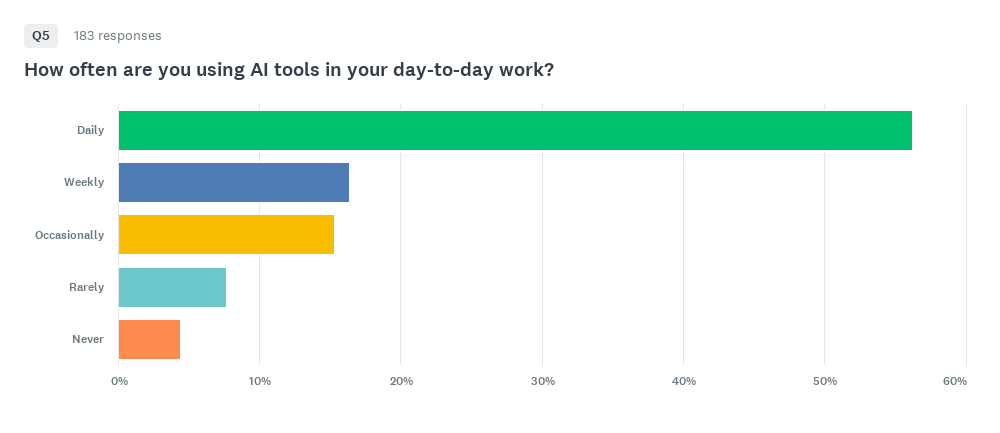
56% of respondents use AI daily at work, but 69% feel negatively about AI's effect on the IT employment.